If you have been comparing DC neighborhoods this summer, you have probably noticed the same headline circulating about Georgetown: prices are down, homes are sitting longer, and the market finally looks like it is loosening its grip. Looking at the rolling three-month window ending in June 2026, the median list price in Georgetown fell more than 18 percent year over year, and days on market jumped sharply enough that the shift shows up in every major tracker. By early July 2026, the average Georgetown listing had been on the market 109 days.
That reads like an opening. It is not quite that simple, and the reason has nothing to do with buyer demand.
A Meeting That Isn't Happening This Month
Here is a detail that matters if you are touring Georgetown homes right now, in late August 2026: the board that decides whether you can change a window, a door, a roofline, or even a paint color on the exterior of a home in this neighborhood does not meet in August at all. The Old Georgetown Board, an advisory panel of three architects appointed by the U.S. Commission of Fine Arts, holds its regular session on the first Thursday of every month except August. The next meeting is September 3, and the filing deadline for that session was August 13, which has already passed. Anyone submitting a new exterior project today is looking at the October 1 meeting, with paperwork due by September 10.
That is not a bureaucratic footnote. If you fall for a Georgetown rowhouse that needs a rear addition, replacement windows, or a new roof, your renovation timeline does not start when you close. It starts on whatever the next available OGB filing deadline happens to be, and every project in this historic district, from a rooftop addition to a business sign, runs through the same three-person board before the District of Columbia will issue a permit.
The Detail Level Most Buyers Never Expect
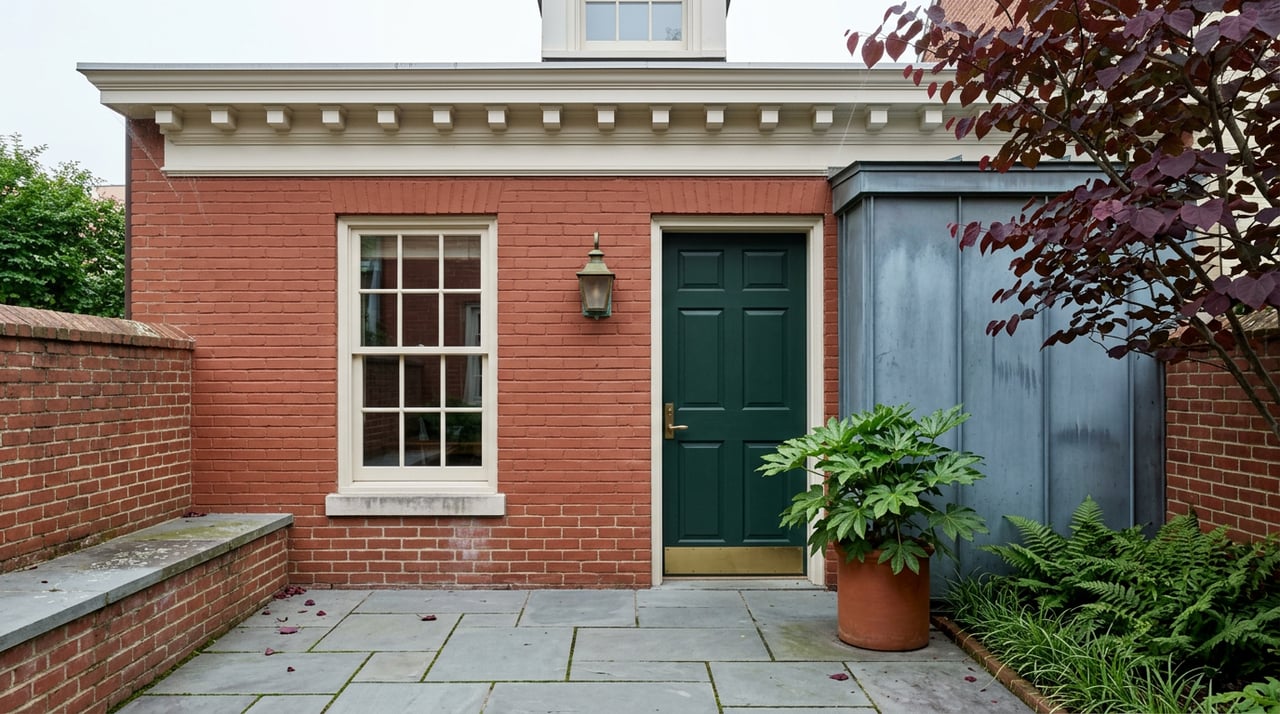
To understand how deep this review goes, look at how the board handled one rear addition and roof alteration case earlier this year. Before the applicant could get a permit, the board required narrower dormer cheek walls, a restudy of the window sash proportions, a physical sample of the pre-patinated zinc panels proposed for the addition, confirmation that the existing front cornice would stay in its original position rather than shift with the new roofline, brick and mortar painted to match the existing facade, and a written specification for a single exterior lantern. The board also required the homeowner to salvage the interior newel post, handrails, and balusters and reuse them in the new staircase.
That level of scrutiny is not an outlier. In the same stretch of 2026 meetings, the board reviewed a sign application for The Ledger, provided the applicant later returned with a separate filing to remove an old sign's light and conduits. It approved a streatery in front of Hershey's Ice Cream on the condition that any plants in the planter be live rather than artificial. It set letter-height limits on an illuminated sign for a business called Flavor Hive. It reviewed window restoration at Georgetown University's McNeir Auditorium down to a cross section confirming a new vent would match an existing one, plus a requirement to salvage a removed transom in case it could be reinstalled later, and it required a ramp added at the House of Sweden to come with detailed drawings of the railing and handrails before work could begin.
None of this is unusual for Georgetown. It is the ordinary cost of doing anything visible from the street in a federally designated historic district established by the Old Georgetown Act of 1950. Interior work that does not touch the exterior generally sidesteps the board entirely. But the moment a project touches a window, a door, a roof, or a facade, it enters a process that industry estimates put at four to twelve weeks depending on scope, with material and design restrictions that can add 10 to 20 percent to the renovation budget itself.
Why Cash Still Runs This Market
That timeline and cost structure explains a number that would otherwise look strange: through the first several months of 2026, roughly 71 percent of Georgetown home sales required no mortgage at all.
A financed buyer typically wants a predictable path from contract to move-in. A rate lock has an expiration date. A construction loan draw schedule assumes a permit is coming on a knowable timeline. Georgetown's review process does not offer that certainty. A concept that needs revisions can bounce back for another round before it ever reaches a permit application, and the board's own guidance notes that projects not approved on the first pass simply resubmit for a future meeting with design changes. For a buyer who wants to close, renovate, and move in on a schedule tied to a mortgage or a construction loan, that variability is a real cost even before the 10 to 20 percent budget premium shows up. Cash buyers absorb that uncertainty because they are not racing a rate lock or a loan officer. That is a large part of why they keep winning this particular market, even as headline prices soften.
Two Markets Wearing One Zip Code
This is also why a single median price tells you almost nothing useful about what your money buys in Georgetown. Condos in the neighborhood start in the mid-$400,000s. Rowhouses range from roughly $1.5 million for smaller, unrenovated properties up to $4 million or more on premier blocks that have already been through the design review process and come out the other side. Detached homes and estates run from $5 million well past $20 million.
The falling median and the stretching days-on-market number are not evenly distributed across that range. They are concentrated in the segment that needs work: homes where a buyer's first move after closing would be a permit application, a board filing deadline, and a multi-month wait. Turnkey homes, the ones where the previous owner already absorbed the OGB timeline and cost, are a different product entirely, and they are not softening at the same pace. Zillow's home value tracking, updated through the end of June 2026, put the typical Georgetown home going to pending status in around 14 days, a very different pace than the 109-day average across all active listings. Both numbers are accurate. They are describing two different markets that happen to share a zip code.
Widen the lens and the same pattern holds. Georgetown's typical home value, even after this year's softening, sits around $1.66 million against a citywide DC median of roughly $700,000, and the neighborhood carries about 3.2 months of supply compared to 4.9 months across the district as a whole. Georgetown is not becoming an easy market. It is becoming a market with a wider spread between the price of a home that is ready to live in and the price of one that still has to clear a design review board before it is.
What to Ask Before You Write an Offer
If you are weighing a Georgetown property against a comparable rowhouse in Capitol Hill or Dupont Circle, and the Georgetown listing looks like the better deal on price alone, a few questions will tell you which market you are actually buying into:
- Has the exterior work you are planning already been submitted to the Old Georgetown Board, and if so, at what stage is it?
- Is the change you want a concept-level revision or a permit-level one? They are reviewed separately, and a concept approval does not guarantee a smooth permit approval.
- Does the property sit close enough to the next filing deadline that your timeline is realistic, or are you effectively waiting for the meeting after next?
- If financing is part of your plan, does your lender's timeline assume a permit that has not been approved yet?
None of this applies if you are buying a home where the prior owner already finished the exterior work. It applies directly if the discount that drew you to the listing exists because the work has not been done.
A Few Questions Worth Answering Directly
Does interior renovation in Georgetown require Old Georgetown Board review? Generally, no. The board's authority covers alterations visible from public space. Interior work that does not change the exterior typically falls outside its scope, though major structural or mechanical work still needs standard DC permits and inspections.
Are there tax credits to offset the cost of historic exterior work? The federal Historic Rehabilitation Tax Credit offers a 20 percent credit for certified rehabilitation, but it applies to income-producing historic properties, not owner-occupied residences.
Why don't more Georgetown listings show aerial photography? Georgetown sits inside Washington's Flight Restricted Zone, which limits drone photography. Listings here typically rely on elevated or long-lens photography instead, which is part of why presentation quality varies so much from one listing to the next.
Buying or selling in a neighborhood where the review board itself sets the clock on your renovation is a different kind of transaction than buying in a neighborhood without that layer. It rewards a strategy built around the actual approval calendar, not just the comparable sales sheet. That is the kind of groundwork Jeff Lockard walks Georgetown buyers and sellers through before an offer goes in, not after.
If you are weighing a Georgetown property against something in Capitol Hill, Dupont, or across the river in Annapolis, get a clear read on what you are actually buying. Get a Complimentary Home Valuation and we will talk through the timeline, not just the price.