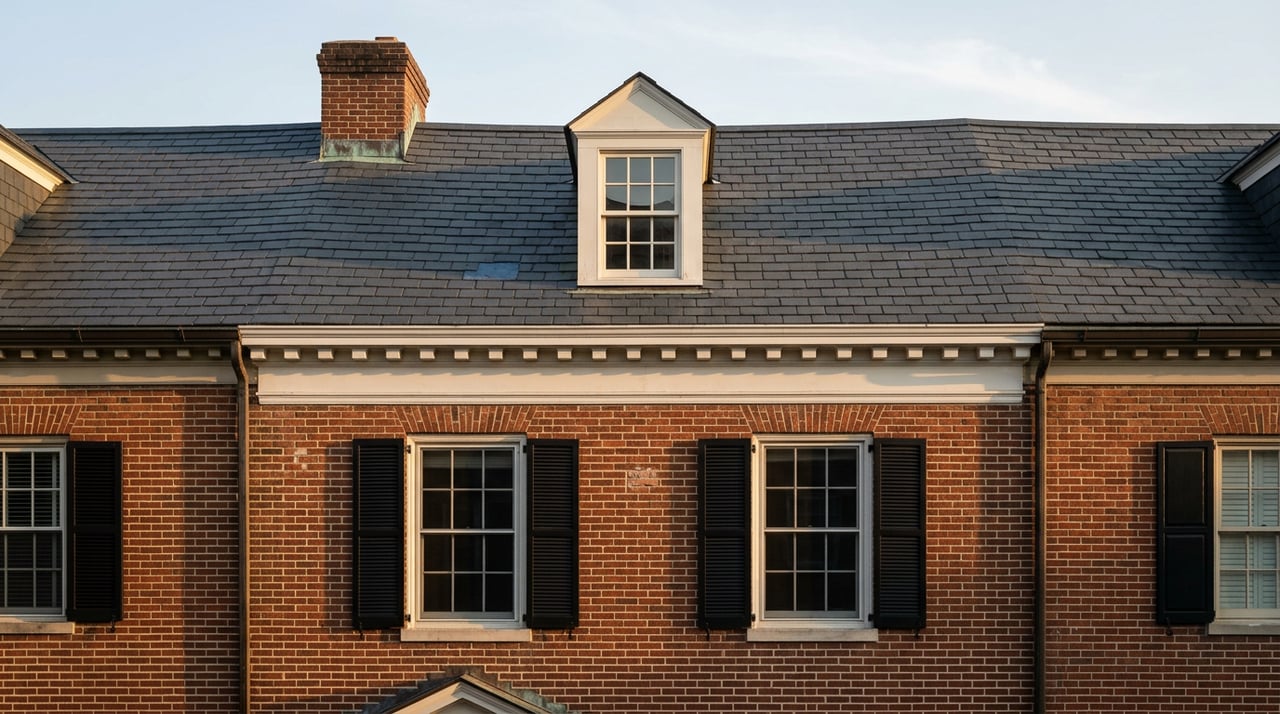
In April, the Old Georgetown Board signed off on a rear addition to one of the neighborhood's Federal-era rowhouses. The list of conditions attached to that single approval ran long. Narrower dormer cheek walls. A restudied sash proportion on the dormer windows. Painted flush wood boards in place of the proposed zinc panels. Pre-patinated zinc on the rear addition itself, with a physical sample required before anyone could proceed. No Low-E coating on any of the new glass. The original cornice held in its existing position rather than raised to meet the new wall height. New brick and mortar painted to match what was already there. A spec sheet for the lantern. And a requirement that the interior newel post, handrails, and balusters be salvaged and reused in the new staircase rather than replaced.
That is what an approved permit looks like in Georgetown. It is exact, conditional, and specific down to the hardware. It is not, however, permanent.
The detail most sellers and buyers miss is that an Old Georgetown Board and Commission of Fine Arts approval carries an expiration date. Once granted, it is good for four years. If construction hasn't substantially started by the time that clock runs out, whoever owns the property has to resubmit for a new review from scratch, under whatever guidelines are current at that point, not the ones the original architect designed around.
That distinction rarely shows up on a listing sheet, and it should. If a seller markets a home with "already-approved plans" as a value-add, and a buyer treats those same plans as a green light to start construction the day after closing, both sides are relying on an asset with a shelf life that neither one has necessarily checked.
What "Approved" Actually Buys You
The mechanics explain why the clock matters more than the paperwork itself suggests. The Board meets once a month, usually the first Thursday, skipping January and August entirely. Complete drawings are due three weeks ahead of that meeting, no exceptions for urgency. Earlier this year, the filing deadline for the Commission's May meeting fell on April 16, three full weeks before the board even convened.
Approval isn't final at that meeting either. The Board's recommendations get compiled into an Old Georgetown Appendix that goes to the full Commission of Fine Arts roughly two weeks later, and the Department of Buildings won't release a permit until that final CFA action happens. A straightforward, uncontested project still needs to clear two separate meeting cycles before anyone can legally break ground. In practice, that means a four-to-twelve week runway depending on scope, which sounds tight until you set it against the four-year window the resulting approval is actually good for.
That gap between a few weeks of review and four years of shelf life is exactly where inherited plans get risky. A buyer who finds a rendering on the seller's refrigerator and assumes it means "ready to build" is skipping the one question that actually matters: how much of that four-year window is already gone.
Same House, Two Different Regulatory Paths
Not every visible change gets the same scrutiny, and not every change needs Board review at all. Earlier this year, a Georgetown homeowner submitted plans for a basement addition, new square footage in a rowhouse inside the historic district Congress carved out in 1950. On paper, it looked like a textbook case for the Board. Instead, a site visit confirmed the addition wouldn't be visible from the public way, and the file was handed to the Historic Preservation Review Board instead. No design critique. No back and forth on materials. The project simply wasn't the Old Georgetown Board's problem.
Compare that to a rooftop replacement reviewed earlier this year, which went through full scrutiny precisely because it could be seen from the street: the Board required the copper panels on the gable pediment be replaced in kind and asked for documentation of the existing gutter type before signing off.
Interior work sits outside this entirely. A gutted kitchen, a reconfigured basement, new mechanical systems tucked inside the walls, none of it triggers historic review of any kind, and none of it comes with an expiration clock because there was never an approval to expire.
The practical takeaway for anyone evaluating renovation upside on a Georgetown property: don't just ask whether plans are approved. Ask which path they took. Work that went through the Old Georgetown Board and CFA is on the four-year clock. Work that went through HPRB because it wasn't visible from the street may carry a different timeline entirely. Interior scope was never on a clock at all.
Why the Calendar Is Fuller Than Usual Right Now
This year's construction activity makes the clock issue more common than it has been in a while. EastBanc's Miradoro project at 2715 Pennsylvania Avenue NW is bringing seven luxury residences, including a penthouse up to 3,600 square feet, to a site the developer's principal, Philippe Lanier, described as the first crane the neighborhood has seen in six years. The Hoya Hotel on Georgetown University's campus went through its own renovation and rebrand, reopening earlier this year.
More projects moving through the same monthly cycle means more precedent being set case by case, and more sellers running into the review calendar mid-renovation for the first time, often after a contractor is already scheduled and the timeline is harder to adjust.
A smaller number of Georgetown properties carry an additional layer worth knowing about. The Foundation for the Preservation of Historic Georgetown, founded in 1965 specifically because the original Act lacked enforcement teeth, holds preservation easements on 114 properties in the neighborhood as of spring 2026. The Foundation has no formal approval authority, but it shapes the conversation around any project near a property already under easement, and it's worth checking before you assume a renovation timeline based on the Board process alone.
As of 2026, industry practitioners in Georgetown commonly budget an additional 10 to 20 percent on renovation costs to cover the materials and design specifications the Board requires. That premium and the four-to-twelve week review window are real costs. They are not, however, the part that catches people off guard at closing. The four-year expiration is.
What This Means If You're Selling
Before you list a home with any exterior work in its history or its future, a short list is worth working through:
- Pull every Old Georgetown Board approval letter and stamped drawing tied to the property, and check the issuance date against the four-year clock. An approval from three and a half years ago is not the same asset as one granted last month.
- Separate cosmetic staging from anything that touches the exterior. Start the review clock the moment you know a project is visible from the street or alley, not after a contractor is already on the schedule.
- If any exterior work happened without approval during your ownership, address it before a buyer's attorney finds it during due diligence. An unpermitted alteration can become a genuine negotiating point at the table.
What This Means If You're Buying
An approval is a countdown, not a guarantee.
- Ask for the permit history, not just the renderings. A rendering tells you what someone designed. A permit history tells you what's actually been approved and when.
- Confirm whether the approval ran through the Old Georgetown Board and CFA, meaning it's on the four-year clock, or through HPRB because the work wasn't visible from public space, which is a different process with different timing.
- Treat an approval nearing its fourth year as a deadline you're inheriting, not a bonus you're getting for free, and price the redesign risk into your offer accordingly.
A Short FAQ
What happens if approved plans expire before construction starts? The project has to be resubmitted for review from scratch, evaluated against whatever design guidelines are current at that time rather than the ones the original approval was granted under.
Does every renovation in Georgetown need Board approval? No. Interior-only work, from kitchen gut renovations to new mechanical systems, falls entirely outside the Old Georgetown Board's jurisdiction because the Board's authority covers only what's visible from a public street or alley.
How can I find out if a specific Georgetown property has prior OGB history? Commission of Fine Arts staff can be reached directly to help determine the review status and history tied to an address, and approved case records are published online once final action is taken.
A Georgetown listing with exterior work in its past deserves the same level of documentation as its staging and photography. If you're weighing a sale or a purchase where renovation history is part of the value story, that permit file is worth reviewing before the listing photos are taken, not after an offer arrives. Jeff Lockard has spent decades pairing Georgetown's design review realities with the presentation and negotiation clients expect at this level. Reach out for a complimentary home valuation and a straight read on where your property's approval history actually stands.